Yes, this is the season of planning for me! :) I am really working to organize and get some clear
thoughts about the upcoming school year - both home-making and school ideas. My hope is to
have a “well oiled machine”.... :) HA! My actual hope is to be able to have enough structure and
organization that we actually get some things done! :)
I have been reading Karen Andreola’s Pocketful of Pinecones the last couple of days. I had tried to read it before and had never had enough time, or it wasn’t the top priority at that moment... whatever. But I have almost read the entire book yesterday and today. Guess it was finally the right moment! :)

I have been taking lots of great notes from this book and think I finally have an idea in my head about how we are actually going to implement nature study into our year. This is something that has always been on my heart to do, but we have never done it well. I have to say this book has really sparked my imagination and given me a framework to work within. Very exciting! I will copy some of my notes here in case you are also interested.
You can use a simple black and white Composition Notebook for each child as their Nature Notebook. This will be the main book, but you will do a lot of drawing on plain pieces of paper and then cutting and pasting into the Nature Notebook. Get a clipboard for each child with a pencil attached by string. Always have several sheets (but not too many) of plain paper on the clipboard, ready to go. You will want to paste the drawings on each right hand side page of the Composition/Nature Notebook, leaving the left hand side for writing. In this way you will only glue on one side of the page and it will look nice. The lined pages of the Composition book make it easy to write neatly beside and under the pasted on drawings/sketches.
Resources to have on hand...
I have the Comstock Nature Study book and have always loved it, but have been overwhelmed about how to use it. It is about 900 pages! But, I now have a clear plan. I will be going through and choosing about 36 different (seasonal) subjects from the book - then use 1 per week for our nature study/notebooks. The Comstock Nature Study book guides you through an observation lesson, questions to ask to get children to think and observe more carefully, and information about the subject. Then, have the children draw/sketch what they are observing. After gluing that in their Nature Notebook, have them dictate what they learned during the observation and questioning. We can work together on this and I will write it on the chalkboard/whiteboard for them to copy into their Nature Notebooks. Also, be sure to include poems that go along with the subject and hymns. Pocketful of Pinecones has several examples of this and there are many poems included in the Comstock book, as well.
Also, choose one spot that you will revisit during each season to record the seasonal changes. This could be a favorite tree, a garden, a woods, a trail... whatever you choose. You will visit this subject throughout the year and draw it in each of the 4 seasons to compare/contrast the seasonal changes.
Here are a couple of things that I just like and plan to incorporate into the boys copywork for their Nature Notebooks.
No shade, no shine, no butterflies,
no bees, no fruits, no flowers,
no leaves, no birds, No-vember.
--Thomas Hood
“Nature is not secretive, but will reveal things only to those who look.”
Some great hymns and songs to incorporate into the Nature Study notebooks...
Winter Nature Walks -
Which plants remain green and which have thorns? Great to go along with “The Holly and theIvy”. Be sure to read the books Night Tree and Owl Moon. Maybe even choose a tree of your own to have as your own “Night Tree”.
Include constellations in your Nature Notebook. You can revisit the same constellation (for instance the Big and Little Dippers) during each season and draw their position/direction change each time. Comstocks Nature Study book offers observation lessons and Constellation Charts that are helpful. Perhaps read Follow the Drinking Gourd as well.
Make Suet Balls - dip in sunflower seeds and cracked corn - hang on lower branches of trees - then observe and draw the bird friends who come to feast.


I have been reading Karen Andreola’s Pocketful of Pinecones the last couple of days. I had tried to read it before and had never had enough time, or it wasn’t the top priority at that moment... whatever. But I have almost read the entire book yesterday and today. Guess it was finally the right moment! :)
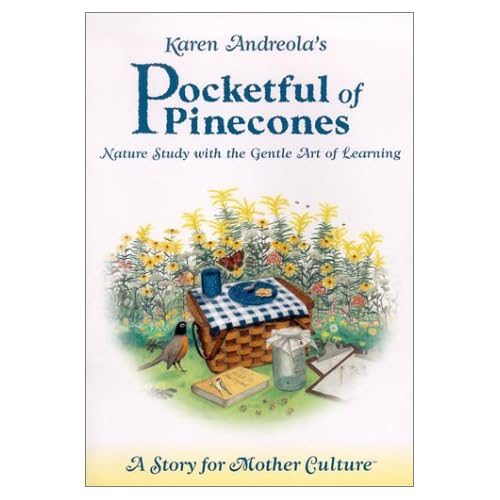
I have been taking lots of great notes from this book and think I finally have an idea in my head about how we are actually going to implement nature study into our year. This is something that has always been on my heart to do, but we have never done it well. I have to say this book has really sparked my imagination and given me a framework to work within. Very exciting! I will copy some of my notes here in case you are also interested.
You can use a simple black and white Composition Notebook for each child as their Nature Notebook. This will be the main book, but you will do a lot of drawing on plain pieces of paper and then cutting and pasting into the Nature Notebook. Get a clipboard for each child with a pencil attached by string. Always have several sheets (but not too many) of plain paper on the clipboard, ready to go. You will want to paste the drawings on each right hand side page of the Composition/Nature Notebook, leaving the left hand side for writing. In this way you will only glue on one side of the page and it will look nice. The lined pages of the Composition book make it easy to write neatly beside and under the pasted on drawings/sketches.
Resources to have on hand...
- Handbook of Nature Study by Anna Botsford Comstock
- Field guides that apply to where you live
- Lots of paper, colored pencils, watercolors (optional), high quality glue for pasting (rubber cement is often recommended)
- library card! (for more in-depth study of anything that interests you - and for those questions you can’t answer)
I have the Comstock Nature Study book and have always loved it, but have been overwhelmed about how to use it. It is about 900 pages! But, I now have a clear plan. I will be going through and choosing about 36 different (seasonal) subjects from the book - then use 1 per week for our nature study/notebooks. The Comstock Nature Study book guides you through an observation lesson, questions to ask to get children to think and observe more carefully, and information about the subject. Then, have the children draw/sketch what they are observing. After gluing that in their Nature Notebook, have them dictate what they learned during the observation and questioning. We can work together on this and I will write it on the chalkboard/whiteboard for them to copy into their Nature Notebooks. Also, be sure to include poems that go along with the subject and hymns. Pocketful of Pinecones has several examples of this and there are many poems included in the Comstock book, as well.
Also, choose one spot that you will revisit during each season to record the seasonal changes. This could be a favorite tree, a garden, a woods, a trail... whatever you choose. You will visit this subject throughout the year and draw it in each of the 4 seasons to compare/contrast the seasonal changes.
Here are a couple of things that I just like and plan to incorporate into the boys copywork for their Nature Notebooks.
No shade, no shine, no butterflies,
no bees, no fruits, no flowers,
no leaves, no birds, No-vember.
--Thomas Hood
“Nature is not secretive, but will reveal things only to those who look.”
Some great hymns and songs to incorporate into the Nature Study notebooks...
- “I Sing the Mighty Power of God” by Isaac Watts
- “This is My Father’s World”
- “Morning Has Broken”
- “The Holly and the Ivy”
Winter Nature Walks -
Which plants remain green and which have thorns? Great to go along with “The Holly and theIvy”. Be sure to read the books Night Tree and Owl Moon. Maybe even choose a tree of your own to have as your own “Night Tree”.
Include constellations in your Nature Notebook. You can revisit the same constellation (for instance the Big and Little Dippers) during each season and draw their position/direction change each time. Comstocks Nature Study book offers observation lessons and Constellation Charts that are helpful. Perhaps read Follow the Drinking Gourd as well.
Make Suet Balls - dip in sunflower seeds and cracked corn - hang on lower branches of trees - then observe and draw the bird friends who come to feast.
Play pinecone “detective” (taken from Pocketful of Pinecones). Gather some pinecones from your
yard, neighborhood, park (wherever you have access) and then have the children find the tree
they came off of. Use a pocket knife to cut off a small piece of branch (if you own the tree) and
smell the fragrance. If you can, take samples of each tree home for further observation and
drawing.
Capture snowflakes! Catch snowflakes on black cloth and observe with a magnifying glass. See how all have 6 sides, but no two snowflakes are alike. Be sure to read Snowflake Bentley and also try to check out one of his books of photographs of snowflakes.
Also in winter - be sure to look for tracks in snow. Use a Tracks field guide to help you determine “who” has been there. Be sure to make your Winter drawing of your chosen spot.
Spring Nature Walks -
Study the earthworms that are coming to surface now.
Also study the robins and watch closely for birds building their nests. You might want to lay some yarn over a bush to give birds some material to build their nests. Sing and copy the hymn “HisEye is on the Sparrow”. Another good piece for copying in the notebook is the Emily Dickenson poem “A Bird”.
Closely observe tree blossoms.
Draw Daffodils. Copy Shakespeare quote, “When daffodils begin to peer.... Why, then comes in the sweet o’ the year.”
This is all I have right now - but I will add Summer and Fall ideas soon. :) Capture snowflakes! Catch snowflakes on black cloth and observe with a magnifying glass. See how all have 6 sides, but no two snowflakes are alike. Be sure to read Snowflake Bentley and also try to check out one of his books of photographs of snowflakes.
Also in winter - be sure to look for tracks in snow. Use a Tracks field guide to help you determine “who” has been there. Be sure to make your Winter drawing of your chosen spot.
Spring Nature Walks -
Study the earthworms that are coming to surface now.
Also study the robins and watch closely for birds building their nests. You might want to lay some yarn over a bush to give birds some material to build their nests. Sing and copy the hymn “HisEye is on the Sparrow”. Another good piece for copying in the notebook is the Emily Dickenson poem “A Bird”.
Closely observe tree blossoms.
Draw Daffodils. Copy Shakespeare quote, “When daffodils begin to peer.... Why, then comes in the sweet o’ the year.”

No comments:
Post a Comment
Thank you so much for your comment. I appreciate hearing from you!